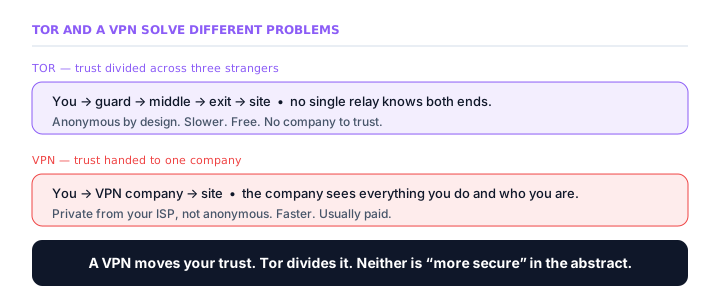
Neither Tor nor a VPN is 'more secure' in the abstract — they solve different problems. Tor provides anonymity by dividing your trust across three independent relays, so no single party can link you to your activity. A VPN provides privacy from your ISP by routing through one company that can see everything. Use a VPN to hide traffic from your ISP; use Tor for genuine anonymity or the dark web.
- Tor divides trust across three relays; a VPN concentrates it in one company
- Tor gives anonymity; a VPN gives privacy from your ISP
- A VPN moves your trust; it doesn't add anonymity
- Neither is universally “better” — they solve different problems
- For the dark web or true anonymity, use Tor
“Tor vs VPN” is one of the most common privacy questions and one of the most muddled, because it's framed as a contest to find the single “more secure” option. That framing is the mistake. They're different tools for different jobs, and the right question is not which is better, but which problem you're solving.
What a VPN does
A VPN routes all your traffic through an encrypted tunnel to a server run by the VPN company, which forwards it to the sites you visit. Your ISP sees only a connection to the VPN; sites see the VPN's address, not yours. It's genuinely useful — but notice where the trust goes. Everything your ISP could previously see, the VPN company now sees instead. You haven't removed a watcher; you've relocated them, from an ISP you didn't choose to a VPN you did.
What Tor does
Tor takes the opposite approach: instead of one trusted company, it routes through three independent relays, so no single point knows both who you are and where you're going. There's no company in the middle to trust, because trust has been divided among parties who don't cooperate.
A VPN asks you to trust one company completely. Tor is engineered so you don't have to trust any single party at all. This is why Tor provides anonymity that a VPN structurally cannot.
Which should you use?
| Your goal | Best tool |
|---|---|
| Hide traffic from your ISP or on public Wi-Fi | A trusted VPN |
| Appear in another location | A VPN |
| Genuine anonymity (no one can link you) | Tor |
| Reach the dark web | Tor |
| Get around censorship safely | Tor (with a bridge) |
Should you use them together?
The most common follow-up question is whether combining Tor and a VPN gives you the best of both. Usually not — and the two possible orders behave very differently.
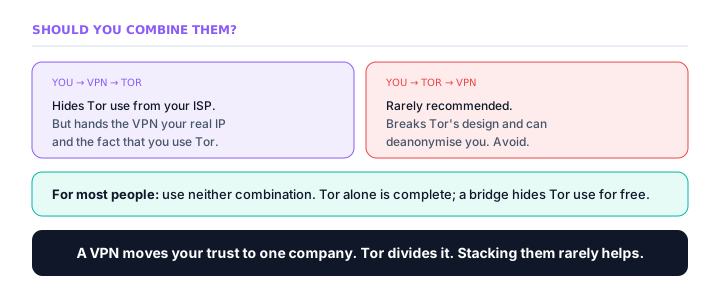
VPN → Tor (connect to a VPN first, then Tor) hides the fact that you use Tor from your ISP — but it hands the VPN company your real IP and the knowledge that you use Tor, replacing a watcher you didn't choose with one you did. Tor → VPN (route out of Tor through a VPN) is rarely recommended and can actively harm your anonymity by breaking Tor's design. For the overwhelming majority of people, the answer is to use neither combination: Tor alone is complete, and if your only concern is hiding Tor use from your ISP, a free built-in bridge does that better than any paid VPN.
Two myths worth killing
“A VPN makes you anonymous.” It doesn't. A VPN gives you privacy from your ISP by moving trust to the VPN company, which can still see who you are and what you do. Anonymity means no single party can link you to your activity — and only Tor's divided-trust design provides that.
“Tor is just a free VPN.” Also false. A VPN routes through one company you must trust completely; Tor routes through three independent relays engineered so you don't have to trust any single one. They're built on opposite philosophies, which is exactly why they suit different jobs.
The bottom line
Stop asking which is more secure and ask what you're protecting against. If the threat is your ISP or a coffee-shop network, a trustworthy VPN fits. If the threat is anyone linking your identity to what you do, only Tor's divided-trust design solves it. They're different instruments — the skill is knowing which your situation calls for. And stacking a VPN onto Tor is rarely the upgrade the affiliate guides claim.
Frequently asked questions
Is Tor or a VPN more secure?
Neither in the abstract — they solve different problems. Tor provides anonymity by dividing trust across three relays; a VPN provides privacy from your ISP by routing through one company. The right choice depends on your threat.
What is the difference between Tor and a VPN?
A VPN routes your traffic through one company that sees your real IP and everything you do. Tor routes through three independent relays so no single one knows both who you are and where you're going. A VPN moves your trust; Tor divides it.
Is Tor a VPN?
No. A VPN is one company you route through and must trust completely. Tor is a network of thousands of volunteer relays engineered so you don't have to trust any single one. They provide different guarantees.
Should I use Tor or a VPN for privacy?
Use a VPN if your concern is your ISP or local network seeing your traffic and you trust a provider. Use Tor if you need genuine anonymity — the dark web, sensitive research, or evading censorship.
Can you use Tor and a VPN together?
You can, but for most people it adds little and hands a VPN company your identity and the fact you use Tor. To hide Tor use from your ISP, the built-in free tool is a bridge, not a paid VPN.
Should you use a VPN with Tor?
For most people, no. Tor alone is complete. Connecting to a VPN before Tor hides Tor use from your ISP but hands a company your real IP; routing Tor through a VPN can harm your anonymity. If you only want to hide Tor use, a free bridge does it better.
Does a VPN make you anonymous?
No. A VPN gives you privacy from your ISP by moving your trust to the VPN company, which can still see who you are and what you do. True anonymity means no single party can link you to your activity — only Tor's three-relay design provides that.
Is Tor safer than a VPN?
Not ‘safer’ in the abstract — they solve different problems. Tor is safer for anonymity, because no single party can link you to your activity. A trusted VPN is fine for privacy from your ISP. The right tool depends on what you're protecting against.